
Choosing sensory wall panels for a school corridor or classroom
A sensory wall panel can make good use of wall space, but the right place for it is not always the first empty wall you find. A busy corridor, a quiet classroom corner and a shared activity room each ask something different of the equipment.
Before looking at colours and shapes, think about who will use the panel and what they will do there. Will someone stop briefly to explore a texture? Will a small group take turns with moving parts? Does a pupil need room to approach in a wheelchair with support alongside them? Those details will help you choose a panel that gets used comfortably.
Choose the activities you want to offer
Wall panels vary considerably. Some provide surfaces to touch. Others include objects to move, visual effects or sounds. Read what each feature actually does rather than treating the word sensory as a complete description.
The Corridor Tactile Wall Panel, for example, brings together a range of tactile and moving features. Its current description also includes illuminated fibre optic elements and recordable sound switches. It is worth asking how those features operate and how they will be used in your setting.
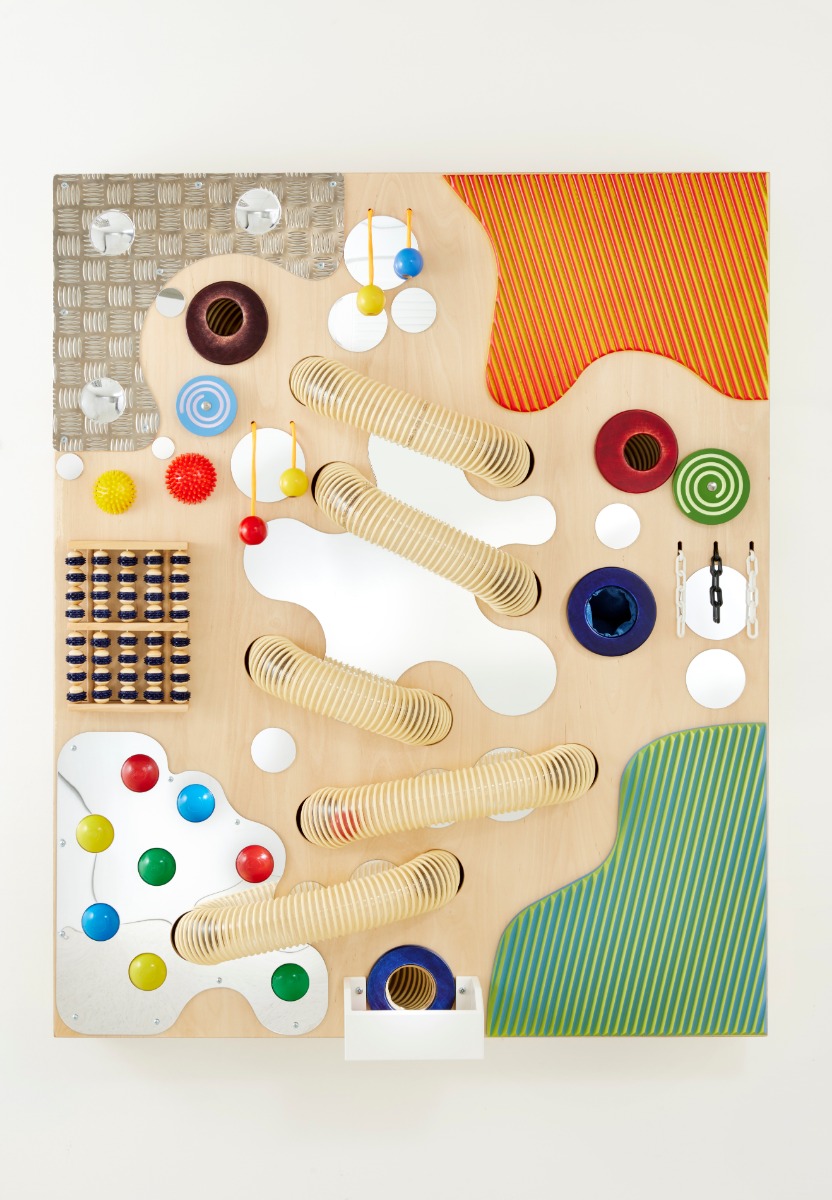
The Tubey Tactile Wall Panel includes ball movement, mirrors and different textures, with a ball collection tray. Someone who enjoys following an object through a tube may be interested in a different part of the panel from someone who prefers exploring a surface by touch.
Use the descriptions to build a shortlist, then ask about the current configuration. Individual components can change. A photograph should not be the only record of what you expect to receive.
A corridor is still a route through the building
A panel may be wall-mounted, but the people using it occupy floor space. Picture a pupil stopping at it with a wheelchair, walker or supporting adult. Then picture other people passing with bags, lunch trolleys or classroom equipment.
Ask your premises and safeguarding teams to review the location. Keep circulation, door swings and emergency routes clear. Measure the depth of the panel as well as its width, and think about where people will wait if someone else is using it.
The same questions apply outside a therapy room or in a reception area. If the activity regularly causes people to gather in the busiest part of a route, moving it to a wider area may be more useful than changing the panel.
Think about the sound around the panel
An activity with a clatter, rattle or recorded message may be welcome in one place and disruptive in another. Listen to the room before adding anything. A panel outside a teaching space can be heard by people who are not taking part.
Ask which features make sounds, whether any settings are adjustable and what happens when several people use the panel together. Avoid assuming a tactile panel is silent simply because it does not look like an electronic toy.
If the purpose of the area is to give someone a break from noise, a busy activity panel may be better placed elsewhere. It is fine for a school to have a lively exploration area and a separate quiet space. They do not need to do the same job.
Make access part of the plan
There is no single mounting height that works for every pupil and every panel. A person's reach depends on their position, movement and the support they use. A feature that can be touched is not necessarily easy to operate.
Use the dimensions and a paper outline to discuss where the main activities will sit. Involve the pupils and, where appropriate, their occupational therapist or other access specialist. Consider the controls and moving parts individually, not only the centre of the board.
Leave enough room to approach and move away comfortably. A user should not have to lean around another piece of furniture or stretch across a hot radiator to reach a favourite feature. Check glare from windows too, particularly where a panel includes mirrors or illuminated parts.
Check the installation before placing an order
Give the installer the exact panel information and let them assess the wall and suitable fixings. Supplied brackets do not establish that every wall construction can support the same installation.
Where a panel needs electricity, plan a suitable supply and safe cable management before it arrives. Keep electrical work with the appropriate competent person. Do not improvise a trailing extension lead through the route pupils use to approach the panel.
Ask how the panel can be serviced and whether components can be replaced. Access to the equipment matters throughout its life, not just on delivery day.
Make care manageable for staff
Shared tactile equipment needs clear care instructions. Ask which cleaning products and methods are approved for the actual materials. Check how moving parts, fabric sections and any electronics should be treated. A general claim about a surface coating is not a substitute for a cleaning routine.
Agree who will check for loose, damaged or missing parts and how a problem is reported. If a feature is damaged, follow the supplier's advice about taking it out of use. Do not leave a note for the next shift and assume the issue has been dealt with.
Keep the product code, instructions and purchase details in a place staff can find. This saves time if a small part needs replacing later.
Your pre-order checklist
- The intended activities and the people who will use them are clear.
- The location has been checked for access, supervision and circulation.
- Noise, light and reflections suit the surrounding space.
- The current configuration and complete dimensions are confirmed.
- Installation, power and fixing arrangements have been agreed.
- Staff know how to inspect, clean and report a problem with the panel.
Once it is installed, watch how the space is actually used. Are the favourite features accessible? Are people comfortable waiting or taking turns? Small changes to nearby furniture or the way an activity is introduced may make a considerable practical difference.
For help choosing, send us a photograph of the proposed wall, its measurements and a description of the users. We can discuss the equipment options while your school team checks the setting and access requirements.

